Akafuji, Beni-Fuji and Diamond Fuji — What's the Difference?
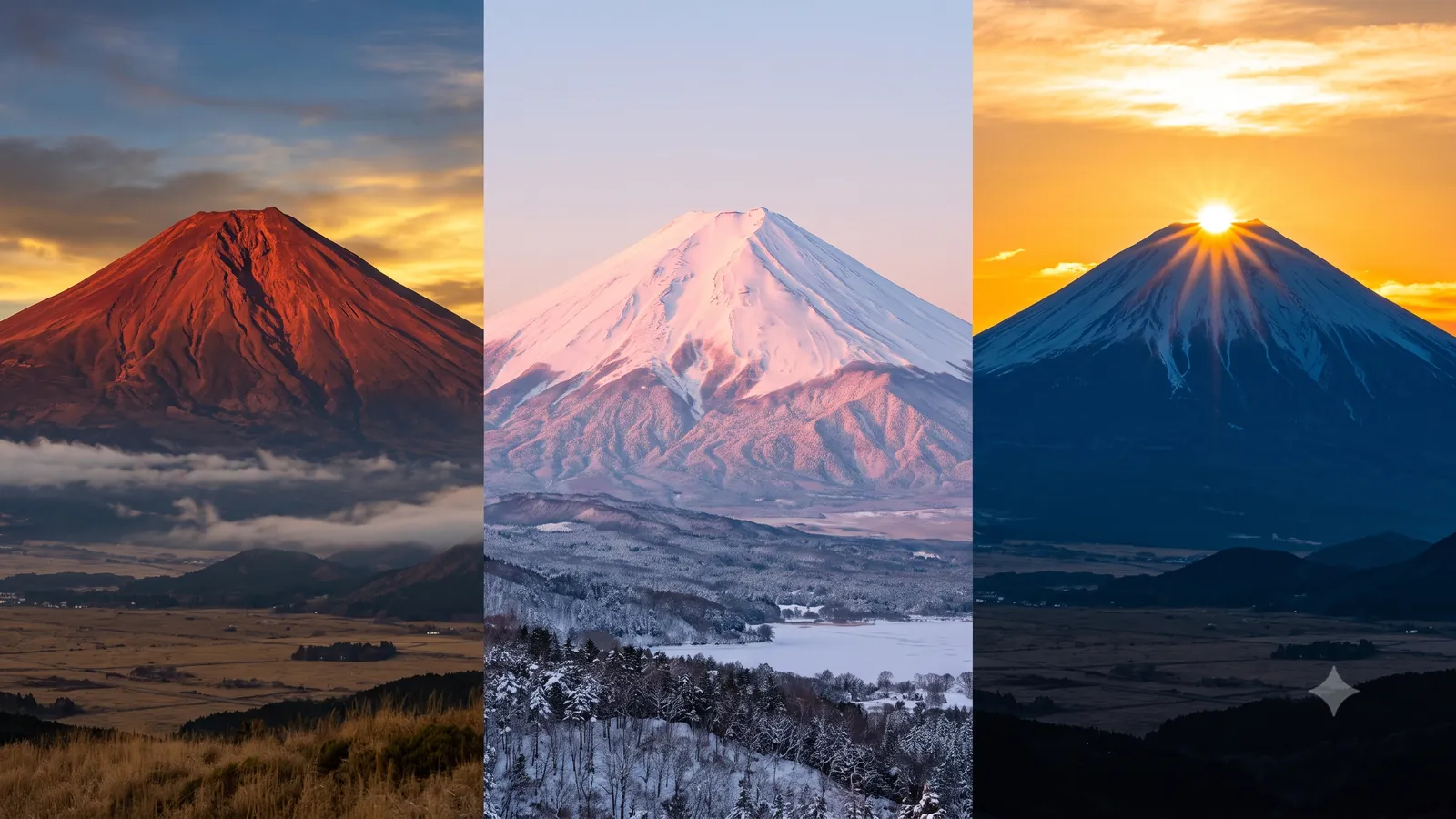
Akafuji, Beni-Fuji and Diamond Fuji all involve Mt. Fuji turning red or catching the light, so they tend to blur together in memory. This article uses dictionary and official definitions plus ephemeris data from the National Astronomical Observatory of Japan (NAOJ) to sort out what separates the three (plus Pearl Fuji) — and states, with reasons, which can be attempted from the Tokaido Shinkansen window and which are ruled out in principle.
Enter your train number and see when Mt. Fuji appears→Akafuji happens on summer mornings
The Digital Daijisen dictionary describes Akafuji ("red Fuji") as a phenomenon in which Mt. Fuji appears red in the early morning from late summer into early autumn, through the interplay of cloud, mist and the morning sun. The Nihon Kokugo Daijiten likewise describes the mountain appearing deep red in the early morning of late summer to early autumn, attributed to a delicate balance of cloud and mist with the morning light; in haiku it is classed as a summer season word. What defines Akafuji, in other words, is the season (late summer to early autumn) and the hour (early morning).
The redness itself works like any sunrise or sunset glow. The Japan Meteorological Agency explains that when the sun is near the horizon, its light passes through a long stretch of atmosphere; the shorter wavelengths scatter away en route, and the longer red wavelengths dominate what reaches the ground.
At that time of year Mt. Fuji carries almost no snow. The first snowcap announced by the Kofu Local Meteorological Office falls on October 2 in an average year, so the late-summer mountain is bare rock and volcanic gravel. That said, the often-repeated formulation that Akafuji specifically means "the snowless mountainside turning red" has no basis we could find in dictionary definitions or official sources.
The famous Akafuji image is Hokusai's "Fine Wind, Clear Morning" (Gaifū kaisei) from the Thirty-six Views of Mount Fuji. According to the commentary on the Tokyo Fuji Art Museum's copy in the Agency for Cultural Affairs' Cultural Heritage Online, it was produced around 1830–32; "gaifū" means a south wind, and on clear early mornings from summer into autumn the whole mountain is said to sometimes glow red.
Beni-Fuji is the snow-covered Fuji taking the color
Beni-Fuji ("crimson Fuji") is generally used for the snow-covered mountain dyed pink to crimson by low morning or evening light. The word, however, has no entry as a Mt. Fuji phenomenon in the major Japanese dictionaries, and we could not find an official source that pins down a definition. The optics are the same as Akafuji; what differs is the surface catching the light — white snow instead of dark rock — and the season, which is winter.
The name is certainly established locally: the municipal hot-spring facility of Yamanakako Village is called "Benifuji-no-Yu" (mentioned on the subsidy page of neighboring Oshino Village). But that is a facility name, not a definition of the phenomenon.
When the mountain acquires its snow is covered in First snow and Mt. Fuji through the seasons.
Diamond Fuji: place and date are decided in advance
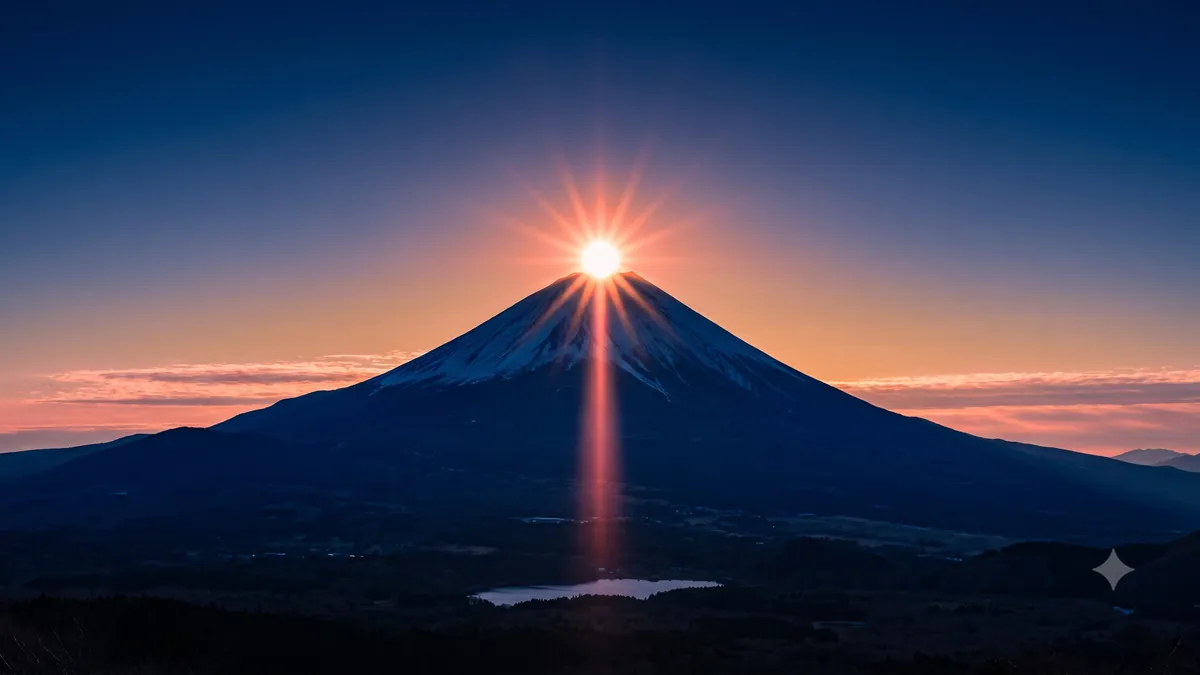
Diamond Fuji is a different kind of phenomenon from Akafuji and Beni-Fuji. The city of Noda describes it as the moment the sun overlaps the summit of Mt. Fuji, blazing there like a diamond. Nothing gets dyed; two things line up. That makes the viewing location decisive.
The MLIT Kanto Regional Development Bureau states that it can be seen from places where Mt. Fuji lies to the east or west, weather permitting, twice a year. Whether it is a morning or evening event depends on where you stand: Noda explains that sunrise Diamond Fuji is always seen from areas west of the mountain, and sunset Diamond Fuji from areas east of it. It happens twice a year because the Earth orbits with a tilted axis, so the sun's rising and setting directions shift a little every day; the moving solar azimuth crosses the fixed direction of Mt. Fuji just twice a year. (Noda itself, sitting at the northern limit where the sunset direction and the mountain's direction can coincide, sees it only once a year.)
How far the sun's azimuth swings can be checked with NAOJ's ephemeris service. At Shizuoka, the sunrise azimuth is 60.3° (measured from north) at the 2026 summer solstice, June 21, and 118.4° at the winter solstice, December 22; sunset azimuths on those days are 299.7° and 241.6°. A place's Diamond Fuji days are the days when "the direction of Mt. Fuji as seen from where you stand" falls inside that swing. Date and time can be computed in advance — but if the place is wrong, no amount of clear sky will show it to you.
Pearl Fuji is the same event with the moon
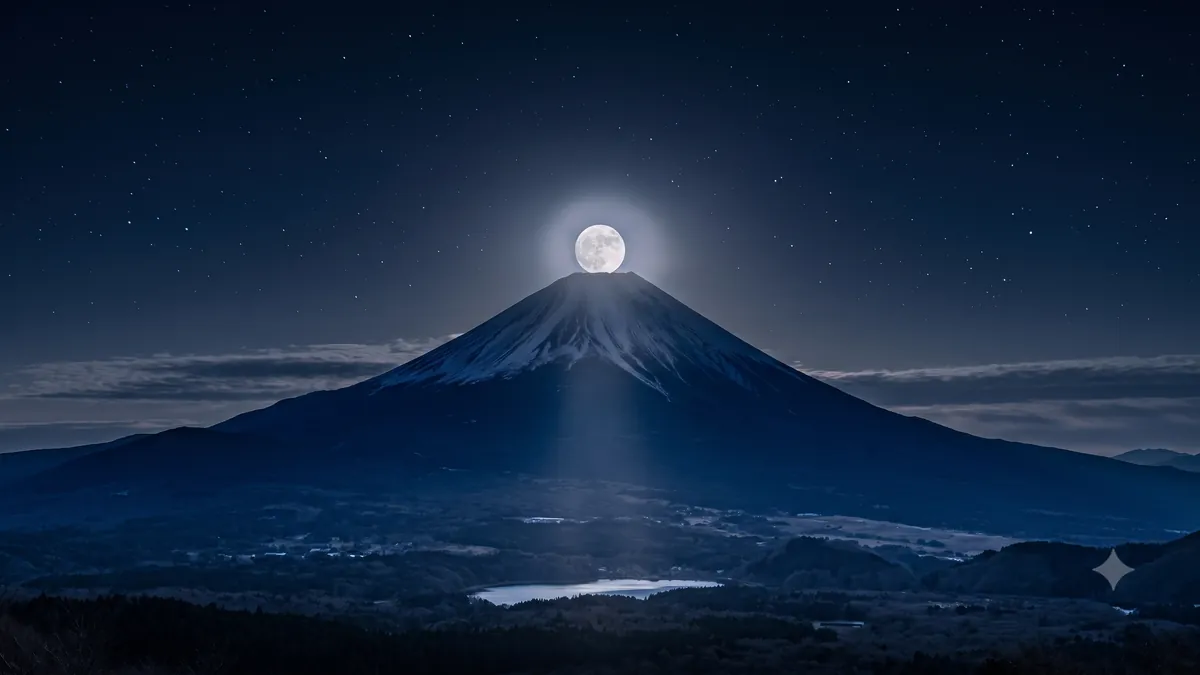
The same alignment with the moon is called Pearl Fuji. The city of Gotemba's official site records a Pearl Fuji viewing event in December 2017, at which participants watched a full moon set onto the summit of the crimson-lit mountain. Again, we could find no official definition of the term. Unlike the sun, the moon has phases, so the moment must satisfy two conditions at once — a nearly full moon, and moonrise/moonset direction and time lining up — which makes opportunities scarce.
Which of these can you catch from the Shinkansen?
The conclusion first: Diamond Fuji and Pearl Fuji are not train-window events. Akafuji is also difficult because of the hour. The one with a real chance is Beni-Fuji on a winter evening.
Diamond Fuji fails for reasons of direction. The Tokaido Shinkansen runs east–west along the south side of Mt. Fuji, and near Shin-Fuji Station — where the mountain looks biggest — Fuji lies almost due north. But the sun's rising and setting azimuths at Shizuoka reach only 60.3° and 299.7° even at the summer solstice, their most northerly. The sun never rises or sets in the northern sky, so in the prime viewing section the alignment is impossible in principle. In sections farther east or west of the mountain there can be spots that satisfy the azimuth condition, but the train passes any such spot in seconds, so the instant of passage would have to coincide with sunrise or sunset. It is not something you can aim for.
Akafuji is hard because of the clock. Sunrise at Shizuoka is 4:56 on August 1 and 5:18 on August 31 (NAOJ). Meanwhile, the earliest Tokyo-bound Nozomi in JR Central's March 2026 revision materials leaves Shin-Osaka at 6:00 and Nagoya at 6:49, arriving in Tokyo at 8:23 — it draws level with Mt. Fuji in the late 7 o'clock hour. Westbound, the first departure in the March 14, 2026 timetable data this site uses leaves Tokyo at 6:00 (Nozomi 1), passing the mountain around 6:40 by our estimated offsets. Either way, that is more than an hour after sunrise, when Akafuji appears.
Beni-Fuji has a chance because winter days are short. Sunset at Shizuoka is 16:35 on December 1 and 16:39 on December 22 (NAOJ) — hours when plenty of Shinkansen are running. Being at the window just as the snow-covered mountain takes the evening light is entirely possible. Sit on the left side heading toward Tokyo, the right side heading west; the line passes south of the mountain, so it is the same window side in both directions — seat E in ordinary cars, seat D in Green Cars. Even in winter, though, there are days when cloud hides the mountain, and evenings bring backlight and window reflections. Board expecting not to see it, and let a sighting be the bonus.
To find when your own train passes Mt. Fuji, enter its number on Mt. Fuji from the Shinkansen (the time calculator). Shin-Fuji is a pass-through station for Nozomi with no official passing time, so the displayed times are estimates. The weather card on the same screen shows the sunset time near Fuji City; compare it with your passing time to judge whether you land in the Beni-Fuji window. For shooting technique, see How to photograph Mt. Fuji from the Shinkansen window.
Sources
- Agency for Cultural Affairs, Cultural Heritage Online: "Fine Wind, Clear Morning" from Thirty-six Views of Mount Fuji (Tokyo Fuji Art Museum) (in Japanese)
- Kotobank, "Akafuji" (Digital Daijisen / Nihon Kokugo Daijiten) (in Japanese)
- JMA, "On Clouds, Atmospheric Phenomena and Optical Phenomena" (in Japanese)
- Kofu Local Meteorological Office, "Announcement of Mt. Fuji's First Snowcap Observed from Kofu" (Oct 23, 2025; PDF, in Japanese)
- MLIT Kanto Regional Development Bureau, "Diamond Fuji" (in Japanese)
- Noda City, "Series 19: Diamond Fuji, an Artistic Moment Woven by Mt. Fuji and the Sun" (in Japanese)
- NAOJ Ephemeris Computation Office, "Calendar for Shizuoka" (in Japanese)
- NAOJ Ephemeris Computation Office, "Calendar Outline 2026: Solar Terms and Seasonal Days" (in Japanese)
- JR Central, "On the March 2026 Timetable Revision" (Dec 12, 2025; PDF, in Japanese)
- Gotemba City, "Pearl Fuji Viewing Event at Mikuriya Kitchen" (in Japanese)
- Oshino Village, "Subsidy for Yamanakako Village Hot-Spring Facilities (Benifuji-no-Yu, Ishiwari-no-Yu)" (in Japanese)
All illustrations on this page are AI-generated images, not photographs of the actual scenery.