Mt. Fuji's First Snowcap, and How the Snow Changes with the Seasons
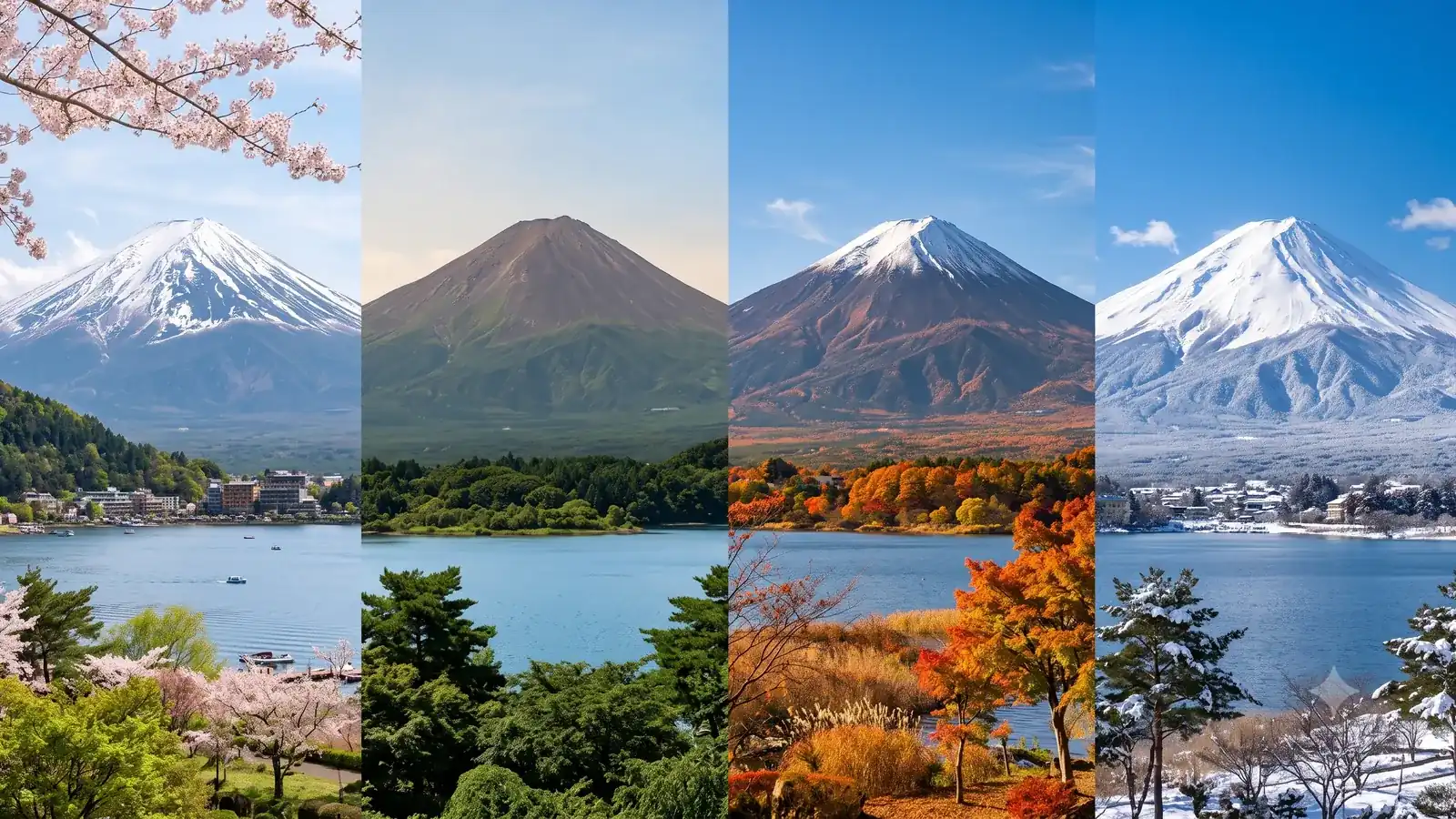
Mt. Fuji's first snowcap (hatsukansetsu) is decided not by the day snow falls on the mountain, but by the day the mountain looks white from the Kofu Local Meteorological Office. This article works through how the definition is put together, the average date and the announcement dates of the past ten years, and when the summit's snow is deepest and when it disappears — using only published JMA figures. It ends with why the summer mountain turns black, and how the seasons change what you see from the train window.
Enter your train number and see when Mt. Fuji appears→The first snowcap is "the day it looked white from Kofu"
In its forecast glossary, the JMA defines the first snowcap as the first accumulation of snow near the summit in the year running from August 1 to July 31. The operative point is that the judgment is visual. The Kofu office's announcements explain "kansetsu" (snowcap) as the state in which all or part of the mountain can be observed from below to be covered with snow, or with white solid precipitation.
The office that observes Mt. Fuji's first snowcap is the Kofu Local Meteorological Office. The announcements are even titled "Notice of Mt. Fuji's First Snowcap as Observed from Kofu," making explicit that the call is made by looking at the mountain from Kofu. Since the definition requires observation from below, a whitened summit that hides in cloud and cannot be confirmed from Kofu is not a first snowcap — even if it looks white from the Shizuoka side.
There is one more condition. The Kofu office notes that the first snowcap is the first snowcap observed on or after the day the Mt. Fuji special regional weather station records the year's highest daily mean temperature. The benchmark is not the temperature at the foot of the mountain, but the warmest day of the year recorded at the summit station.
Because of this constraint, a first snowcap that has been announced can later be withdrawn. In the 2022 cold season, a first snowcap was observed on September 7, 2021 — but the summit's highest daily mean temperature then occurred on September 20, so the September 7 call was revised. On the books, 2021's first snowcap is September 26. The office itself writes that first-snowcap dates may be corrected or moved retroactively.
The average is October 2; reality swings from August to November
The Kofu office puts the climatological average date of the first snowcap at October 2. Actual dates, however, vary considerably. From the office's published records, the last ten years:
| Year | First snowcap |
|---|---|
| 2016 | October 26 |
| 2017 | October 23 |
| 2018 | September 26 |
| 2019 | October 22 |
| 2020 | September 28 |
| 2021 | September 26 |
| 2022 | September 30 |
| 2023 | October 5 |
| 2024 | November 7 |
| 2025 | October 23 |
Observations began in 1894. Across more than 130 years of records, the earliest is August 9, 2008 and the latest November 7, 2024. The 2024 date was 36 days later than average — the latest since records began — and 2025 followed at October 23, 21 days later than average. Planning a trip on the assumption of "a white Fuji once October comes" is, on recent form, a little risky.
Separately from the meteorological office, the city of Fujiyoshida in Yamanashi declares its own "first snow makeup" (hatsuyuki-gesho); in 2025 the declaration came on October 23. The city states clearly that this is its own declaration, distinct from the Kofu office's first snowcap.
The snow is deepest not in winter but in spring
In the JMA's climatological normals for the summit of Mt. Fuji, the month with the greatest maximum snow depth is April, at 206 cm — followed by May at 196 cm and March at 187 cm. Midwinter January stands at 125 cm and February at 128 cm: spring outranks winter. The statistics cover 1991–2004 and are treated by the JMA as reference values.
The summit temperatures make sense of this. In the same normals, the monthly mean is −18.2°C in January, −8.8°C in April and −3.2°C in May. Even in spring the summit stays below freezing, so the snow that falls piles up with little melting. The mean first climbs above 0°C in June, at 1.4°C, and even the warmest month, August, reaches only 6.4°C. Maximum snow depth falls off a cliff accordingly: 121 cm in June, 11 cm in July, 0 cm in August.
In short, Mt. Fuji is not white only in midwinter. March through May is when the mountain wears its deepest snow.
The summer Fuji is black rock
The season when the snow disappears coincides with the climbing season. Shizuoka Prefecture sets the open season for its three trailheads at early July to September 10. In 2026, per the official Mt. Fuji climbing site, the Yoshida and Subashiri trails opened on July 1, and the Fujinomiya and Gotemba trails, along with the summit crater circuit, on July 10. The window when you can climb and the window when summit snow depth reads 0 cm largely overlap.
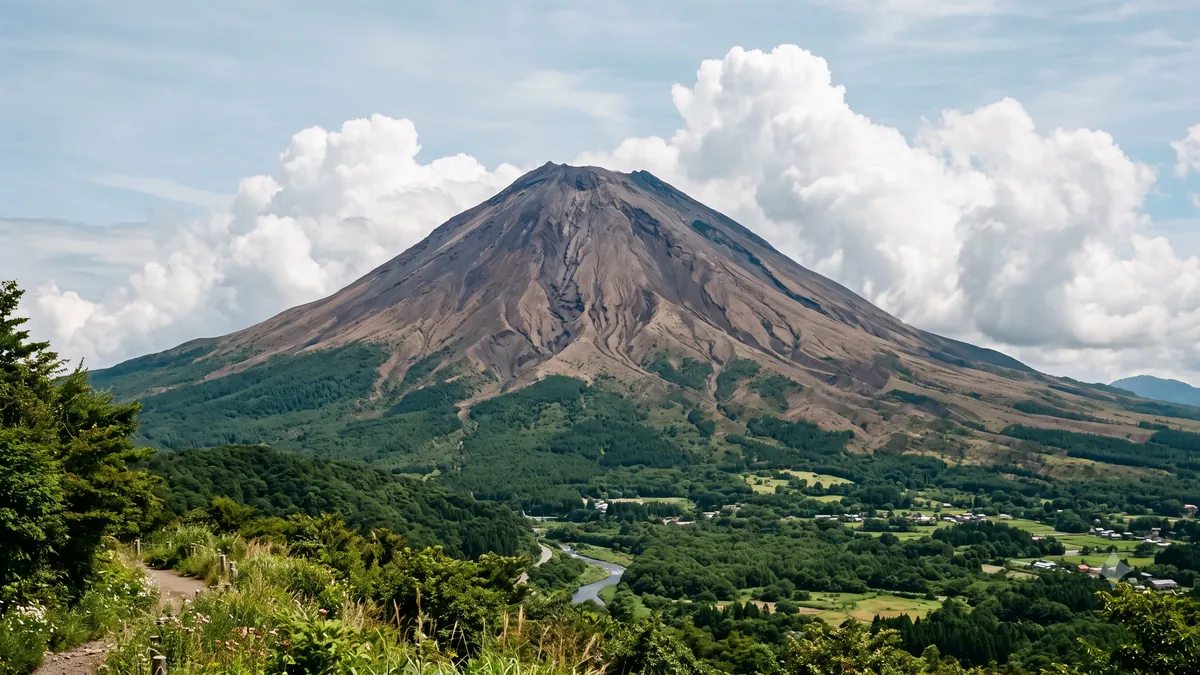
The mountain in that season is a different creature from the white peak of the photographs. With no snow to the summit, it is a black mountain of bare rock and volcanic gravel. Akafuji — the mountainside glowing red in the early mornings of late summer and early autumn — is a phenomenon that depends on that black surface. The differences among Akafuji, Beni-Fuji and Diamond Fuji are sorted out in Akafuji, Beni-Fuji and Diamond Fuji — what's the difference?.
From the train, a white Fuji is easier to find
Snow also changes how easy the mountain is to spot from the train. A whitened summit contrasts sharply with the sky and the surrounding ranges, and the outline reads from far away. In summer, with no snow, the color of the bare slopes dissolves into the haze, and you can fail to notice a mountain is there at all.
That said, the seasonal difference is decided first at the level of whether the mountain shows at all. In Fuji City's fixed-point observations, the share of 8 a.m. checks with the whole mountain visible is 61.7% in December against 9.9% in July — a gap of more than six times. What lies behind that gap is covered in How often Mt. Fuji is actually visible.
If you want a snow-capped Fuji from the train window, the long favorable stretch runs from autumn, once the first snowcap has been declared, through early spring, when the snow is deepest. Enter your train number to get the passing time for the viewing section and the side to sit on (Mt. Fuji from the Shinkansen (the time calculator)). Shin-Fuji is a pass-through station for Nozomi and Hikari with no official passing time, so the displayed times are estimates.
Sources
- JMA forecast glossary, "Seasonal Phenomena" (in Japanese) — first snowcap: "the first accumulation of snow near the summit between August 1 and July 31 of the following year"
- Kofu Local Meteorological Office, "Notice of Mt. Fuji's First Snowcap as Observed from Kofu" (Oct 23, 2025; PDF, in Japanese) — Oct 23, 2025; average Oct 2; definition of the snowcap; the highest-daily-mean-temperature condition; observations since 1894
- Kofu Local Meteorological Office, "Notice of Mt. Fuji's First Snowcap as Observed from Kofu" (Nov 7, 2024; PDF, in Japanese) — Nov 7, 2024, 36 days later than average and the latest on record; earliest Aug 9, 2008
- Kofu Local Meteorological Office, "First Snowcap Dates for Mt. Fuji and Mt. Kaikomagatake" (PDF, in Japanese) — year-by-year list since 1894; the 2022 cold-season revision
- Kofu Local Meteorological Office, "Climate and Statistics" (in Japanese) — average date Oct 2; earliest and latest
- JMA, "Climatological Normals for Mt. Fuji, Shizuoka — Snow Detail" (in Japanese) — monthly normals for maximum snow depth (1991–2004, reference values)
- JMA, "Climatological Normals for Mt. Fuji, Shizuoka (annual/monthly)" (in Japanese) — summit monthly mean temperatures
- Shizuoka Prefecture, "Climbing Restrictions at the Three Shizuoka Trailheads" (in Japanese) — open season "early July to September 10"
- Mt. Fuji Council for Proper Use, "Official Mt. Fuji Climbing Site" — 2026 opening dates for each trailhead
- Fujiyoshida City tourism guide, "Mt. Fuji 'First Snow Makeup' Declared, Oct 23, 2025" (in Japanese) — declared by the city independently of the first snowcap
- Fuji City, "Records of Mt. Fuji Observation" (in Japanese) — fixed-point observations from city hall; monthly visible rates
All illustrations on this page are AI-generated images, not photographs of the actual scenery.