How to Photograph Mt. Fuji from the Shinkansen Window
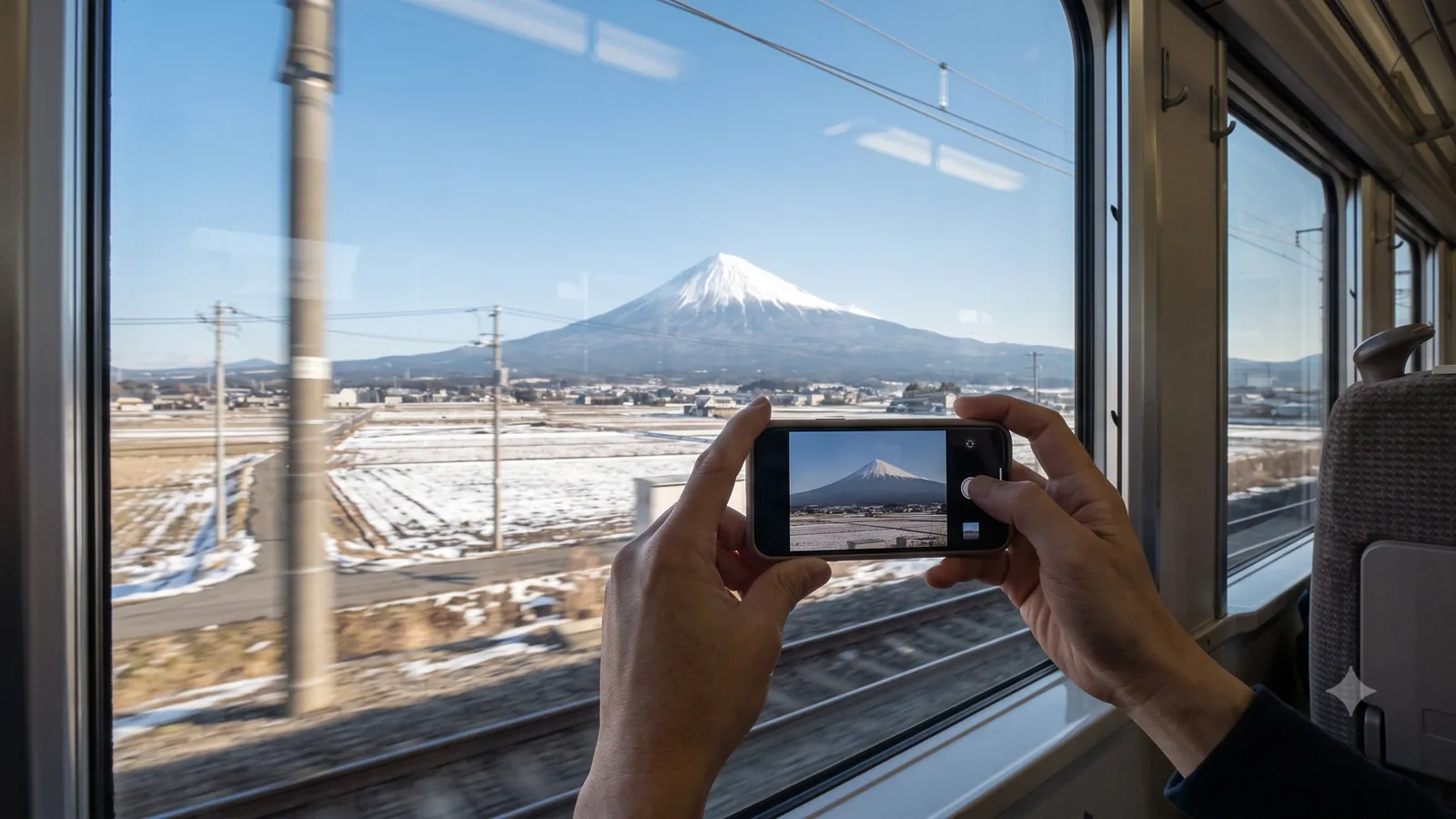
Shoot Mt. Fuji through the glass of a moving train and the picture usually fails in one of three ways: a wall flashes across the foreground, the carriage interior reflects in the window, or the moment has passed before you notice it. This article explains, in order, why Mt. Fuji itself hardly blurs, how to reduce window reflections, and what to actually adjust on a smartphone — and closes with etiquette.
Enter your train number and see when Mt. Fuji appears→Mt. Fuji doesn't blur. The foreground does.
The Tokaido Shinkansen's top speed is 285 km/h, raised from 270 km/h with the timetable revision of March 14, 2015 (JR Central press release). That works out to about 79 meters per second — a number that suggests you would need a very fast shutter.
But how fast a subject streaks across the frame is inversely proportional to its distance from the camera. Moving sideways at the same 79 m/s, a sound barrier 5 m away tears across your field of view, while a distant mountain barely moves. The difference is roughly a factor of several thousand.
How far away is Mt. Fuji? Fuji City's own material gives a sense of scale. The city measures 27.1 km north–south; the south side is the Suruga Bay coastline, the northern edge sits directly below the summit, and the elevation difference is about 3,680 m (Fuji City). The Shinkansen runs through the southern, coastal part of the city, so even after subtracting something from that north–south span, the summit is more than 20 km from your window.
So in daylight, left to auto-exposure, the mountain itself will essentially never streak. The problem is what crosses in front: sound barriers, catenary masts, wires, rows of houses. Raising the shutter speed will freeze the foreground objects, but frozen or not, they still hide the mountain. Don't fight with speed — pick the moments when the foreground opens up. Shooting bursts and keeping the frames without obstacles afterwards is the realistic approach.
Care is needed once the sun gets low. In dim light a smartphone slows its shutter, and now hand shake and carriage vibration do matter. Tuck your elbows in.
Reflections shrink as the lens approaches the glass
The biggest enemy in through-glass photography is the reflected carriage interior. Glass throws the cabin's light back like a mirror: your clothes, the ceiling lights, the white seat headrest covers, the glowing phone in your hands.
The fix is simple: bring the lens as close to the window as you can. The narrower the angle at which you peer into the glass, the smaller the slice of cabin that can reflect. Don't press it against the pane, though — carriage vibration transmits straight through. A few centimeters short of the glass is the right distance.
Clothing color matters too. A white or light-colored jacket reflects straight into the window. Wear something dark on a day you plan to shoot and the reflections visibly drop. Not spreading white paper on the window-side tray follows the same logic.
No flash. The light bounces off the glass straight back at you, leaving a white blob in the middle of the frame — and JR East lists firing a flash at a running train among acts that can interfere with operations (JR East).
The window glass has limits — accept them
A railway car window is not a single pane. According to glassmaker AGC, laminated glass — two panes with a film sandwiched between — is used, and high-speed trains sometimes stack three or more panes against flying-stone impacts. (The exact window specifications of Tokaido Shinkansen rolling stock could not be confirmed in published materials.)
More surfaces mean more reflections, so strong light entering at an angle can produce faint double images or smearing. No technique fixes this; if it appears, all you can do is shift your body and change the lens angle.
Dirt on the outside of the glass behaves the same way. With focus on the distant mountain the dirt itself won't register, but when sunlight strikes it obliquely it scatters the light and washes the whole photo toward white. Glance at the window's condition as you board.
What to actually do on a smartphone
- Lower the exposure. Blue sky and a snow-capped Fuji are both bright, and auto-exposure tends to chase the sky. Long-press on the mountain to lock focus and exposure, then pull the brightness slider down a touch. Blown-out snow cannot be recovered.
- Don't over-zoom. The higher the magnification, the more hand shake is amplified — and when something crosses the foreground it fills more of the frame. Shooting at the standard focal length and cropping later is safer.
- Shoot bursts. Foreground obstacles are a matter of luck, so holding the shutter and choosing later beats aiming one frame at a time.
- Watch the horizon. Train-window shots tilt easily, and straightening a tilted Fuji later means cropping away its surroundings.
The light differs between midday and morning or evening
Fuji City looks up at Japan's highest mountain to the north and out over Japan's deepest bay to the south (Fuji City), and the line passes along the mountain's south side. The sun stands highest at culmination — when it is due south (NAOJ). While the sun rides in the southern sky, the light comes from behind the photographer and the south face of Mt. Fuji, turned toward your window, is lit head-on.
But sunrise and sunset directions swing with the seasons. For Shizuoka at the 2026 summer solstice (June 21), the sun rises at azimuth 60.3° and sets at 299.7° (NAOJ Ephemeris Computation Office) — both well north of due east (90°) and due west (270°). Since Mt. Fuji lies roughly due north of the Shin-Fuji area, on summer early mornings and evenings the light strikes from the side or diagonally ahead rather than from behind you. You don't get the straightforward front-lighting of midday.
Morning and evening sun is also low, so oblique light rakes into the window glass and flares. Be extra thorough about reflections then.
Get ready before the mountain appears
Finally, the thing that helps most. Mt. Fuji is not visible for long — by this site's calculation, roughly five to six minutes from first view to last. Note that Shin-Fuji is a pass-through station for Nozomi and Hikari with no official passing time, so these times are estimates.
Five minutes may sound like plenty, but tunnels and sound barriers keep cutting the view throughout. If you only reach for your phone once the mountain appears, and are still setting exposure, the section where it looks biggest will be over. Know the approximate time in advance and be in position a few minutes early — this alone changes the result. To get the times and the correct side from your train number, use Mt. Fuji from the Shinkansen (the time calculator); for where the mountain looks biggest, see Where Mt. Fuji looks biggest from the Shinkansen.
And if the weather is bad, nothing will save the shot. Days without a view are normal — see How often Mt. Fuji is actually visible for seasonal and time-of-day tendencies.
Etiquette
The carriage is a shared space. Things easily forgotten mid-shoot:
- Don't lean across aisle seats or in front of other passengers. If you don't have a window seat, not shooting is also a valid choice.
- Don't lean far out of your seat or stand pressed against the window; it is dangerous if the train brakes suddenly.
- No flash, for the reasons above.
- Avoid shots that capture other passengers, and avoid posting them.
- Mind shutter sounds and video audio levels.
JR East states that photography within the scope of a personal hobby — excluding commercial activity such as posting to monetized video sites — is "not specifically prohibited, provided there is no safety problem and no nuisance to other passengers." This is JR East's guidance, not a confirmed position of JR Central, which operates the Tokaido Shinkansen, but it serves as a reasonable yardstick.
Sources
- Central Japan Railway, "Ceremony for the Start of 285 km/h Operation on the Tokaido Shinkansen" (Feb 26, 2015; PDF, in Japanese) — top speed raised from 270 km/h to 285 km/h with the March 14, 2015 revision
- Fuji City, "Chapter 1: Overview of Fuji City" (PDF, in Japanese) — city area 23.2 km × 27.1 km; about 3,680 m of elevation difference from the Suruga Bay coastline to the northern edge below the summit; "Japan's highest mountain to the north, Japan's deepest bay to the south"
- NAOJ, "How Is the Sun's Culmination Altitude Calculated?" (in Japanese) — culmination altitude is "the angle above the horizon when the sun is due south at its highest"
- NAOJ Ephemeris Computation Office, "Sunrise and Sunset at Shizuoka, June 2026" (in Japanese) — June 21, 2026 at Shizuoka: sunrise azimuth 60.3°, sunset azimuth 299.7°
- AGC, "Glass for Railway Vehicles" (in Japanese) — laminated glass in rail cars; three or more panes on some high-speed trains
- JR East FAQ, "I want to photograph trains in carriages or on station premises" (in Japanese) — treatment of personal, non-commercial photography; flash use toward running trains
All illustrations on this page are AI-generated images, not photographs of the actual scenery.