e.g. Nozomi 94 → 94
Weather data by Open-Meteo.com
◆Seats with a view of Mt. Fuji
| Car | Seat layout | Mt. Fuji-side window |
|---|---|---|
| Ordinary car | 3 + 2 seats | E |
| Green Car | 2 + 2 seats | D |
?FAQ
- Which side should I sit on?
- Seat E in ordinary cars, seat D in Green Cars. The line runs along the south side of Mt. Fuji, so it’s on the same side whether you’re heading up or down.
- How long is it visible?
- The view opens up for roughly 3–4 minutes around Shin-Fuji Station.
- Will I definitely see it on a clear day?
- No. In Fuji City’s 35 years of records, Mt. Fuji was fully visible on 36.6% of the 8:00 observations and completely hidden on 41.1%. Even on a clear day the summit can be under cloud.
✎Articles
More about Mt. Fuji and the view from the window.
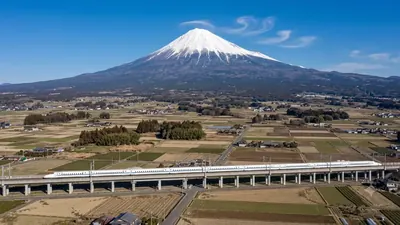 Why Mt. Fuji Is So Easy to See from the ShinkansenWhy does Mt. Fuji dominate the view from the Tokaido Shinkansen?
- Seat E or Seat A? Which Side of the Shinkansen Faces Mt. FujiHeading away from Tokyo, Mt. Fuji appears on the right; heading toward Tokyo, on the left.
- Tokyo to Kyoto or Osaka: Mt. Fuji from the ShinkansenOn the westbound Tokaido Shinkansen — Tokyo to Nagoya, Kyoto, Osaka or beyond — Mt. Fuji appears on the right side of the train, roughly 43 to 49 minutes after leaving Tokyo (this site's estimate).
- Kyoto or Osaka to Tokyo: Catching Mt. Fuji on the Way BackOn the eastbound Tokaido Shinkansen — Kyoto, Osaka or Nagoya toward Tokyo — Mt. Fuji appears on the left side of the train, and the seat letter is the same as on the way out: E in ordinary cars, D in Green Cars.
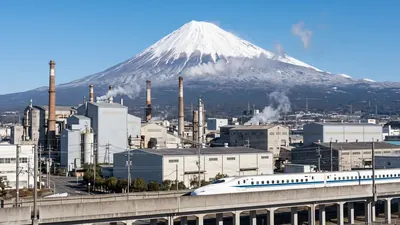 Where Mt. Fuji Looks Biggest from the ShinkansenThe Tokaido Shinkansen passes closest to Mt. Fuji around Shin-Fuji Station in Fuji City, Shizuoka, until it crosses the Fuji River.
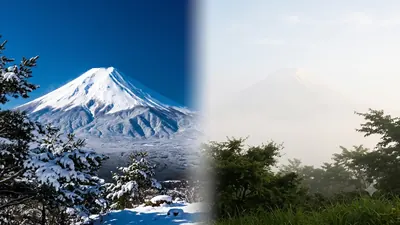 How Often Mt. Fuji Is Actually Visible — Winter vs. Summer, Morning vs. NoonBased on 35 years of fixed-point observations by Fuji City, this article shows how often Mt. Fuji is visible, month by month and by time of day.
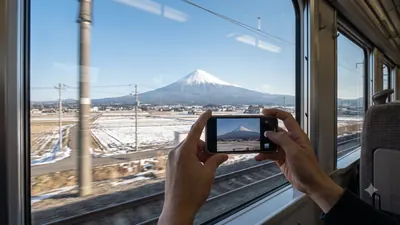 How to Photograph Mt. Fuji from the Shinkansen WindowPractical technique for shooting Mt. Fuji from a Tokaido Shinkansen running at 285 km/h.
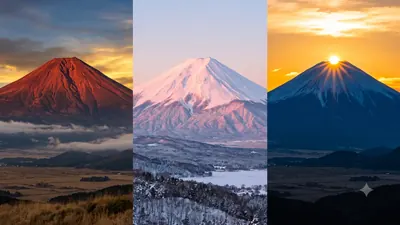 Akafuji, Beni-Fuji and Diamond Fuji — What's the Difference?Akafuji, when the bare mountainside glows red on summer mornings; Beni-Fuji, when the snow-covered mountain blushes at dawn or dusk; and Diamond Fuji, when the sun aligns with the summit.
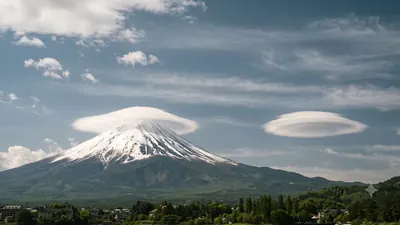 What Cap Clouds and Lenticular Clouds Tell You About Mt. Fuji's WeatherThe cap cloud (kasagumo) that sits on Mt. Fuji and the lenticular "hanging cloud" (tsurushigumo) floating downwind.
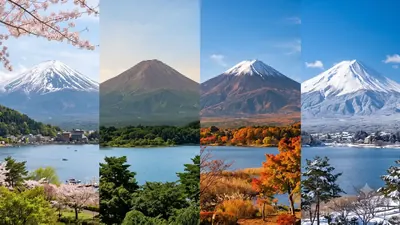 Mt. Fuji's First Snowcap, and How the Snow Changes with the SeasonsMt. Fuji's first snowcap is declared by the Kofu Local Meteorological Office based on what can be seen from Kofu.
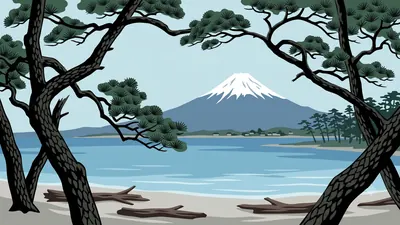 Why Mt. Fuji Is a World Cultural Heritage Site — Not a Natural OneMt. Fuji was inscribed on the World Heritage List in 2013 as a cultural site, not a natural one.
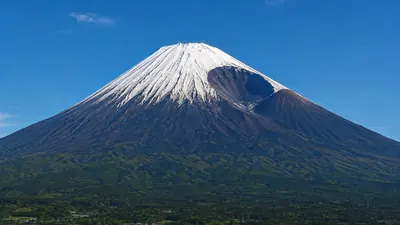 Mt. Fuji the Active Volcano, and the Hoei Eruption of 1707Mt. Fuji is an active volcano monitored around the clock by the Japan Meteorological Agency.
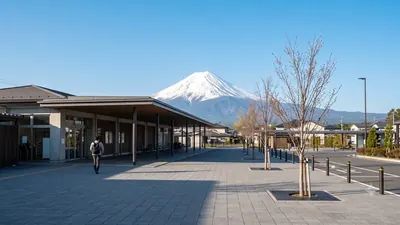 Getting Off the Shinkansen to See Mt. FujiA guide for getting off the Shinkansen at Shin-Fuji, Mishima or Shizuoka and getting close to Mt. Fuji.
All times are Japan Standard Time. For Kodama, which stops at Shin-Fuji, the official station time is used; Nozomi and Hikari pass through without an official time, so those are estimated from standard running times. Either way the viewing window is a guide and shifts by a few minutes with the train and any delays. Covers the Tokaido Shinkansen under the 14 March 2026 timetable, including seasonal extra services. Times change with each timetable revision.