Where Mt. Fuji Looks Biggest from the Shinkansen
The Tokaido Shinkansen comes closest to Mt. Fuji while running through Fuji City in Shizuoka Prefecture — the few minutes from around Shin-Fuji Station until the train crosses the Fuji River. This article describes how the mountain appears in that section, what enters the foreground, and why walls and terrain create stretches where you cannot see it — sticking to what can be verified in official sources. It also touches on how many minutes the mountain stays visible, with one caveat stated up front: the times this site shows are estimates.
Enter your train number and see when Mt. Fuji appears→The closest approach is around Fuji City
JR Central names "between Shin-Yokohama and Odawara, and between Mishima and Shin-Fuji" as the sections where Mt. Fuji can be seen from the train (JR Central). Since the stations from the Tokyo side run Mishima, Shin-Fuji, Shizuoka (JR Central), the latter section is the one that ends at Shin-Fuji Station.
Fuji City, where Shin-Fuji Station stands, measures 23.2 km east–west and 27.1 km north–south, and its northern edge sits directly below the summit of Mt. Fuji. The elevation difference from its coastline on Suruga Bay to the city's northern edge is about 3,680 m, and the city itself explains that it is the only municipality in Japan whose territory runs from the coastline all the way to Mt. Fuji (Fuji City). The rail line cuts across the flat part of the city near the sea.
Mt. Fuji stands 3,776 m tall (GSI). The mountain's height never changes, so the only thing that decides how large it looks in your window is distance. Seen on the same day, the mountain makes a very different impression from around Mishima than from around Fuji City.
Fuji City itself lists Shin-Fuji Station among its Mt. Fuji viewpoints, introducing it with the line that when you step off the Tokaido Shinkansen, Mt. Fuji is there to greet you (Fuji City). The station itself is treated as a place with a view.
Crossing the Fuji River: a few dozen seconds of open sight
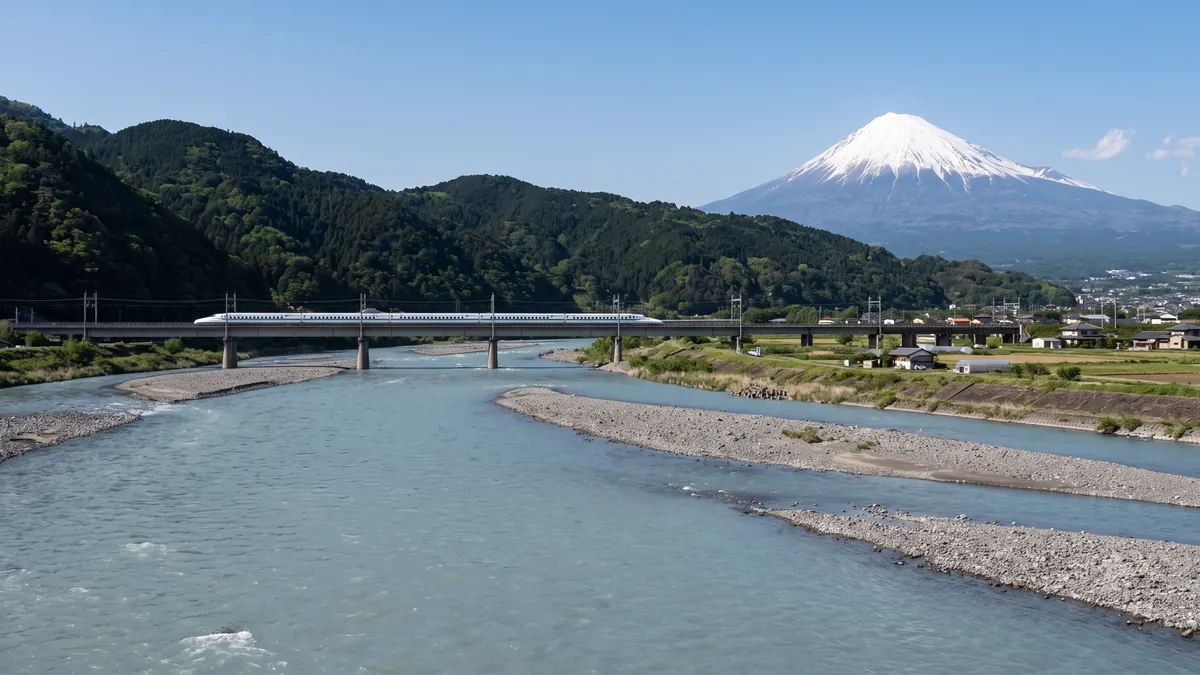
West of Shin-Fuji Station, the line crosses the Fuji River. The Fuji is counted with the Mogami and the Kuma among Japan's three swiftest rivers, and it was historically a waterway linking the old provinces of Kai and Suruga (MLIT Kofu River and National Highway Office).
On the bridge there are, naturally, no buildings on either side of the track. The view that was chopped up by roofs and signboards in the built-up area suddenly spreads wide when the train reaches the river. This brief moment is the only chance to see the water surface and the mountain standing above it as a single picture — if you want a photograph, this is the obvious climax. Fuji City also lists the Fuji River and the Fujikawa Rakuza roadside station among its Mt. Fuji viewing spots (Fuji City).
The west bank of the Fuji River is mostly steep mountain terrain, apart from limited flat land and river terraces (Fuji City). Once the train finishes crossing, the ground underfoot changes: on westbound trains (toward Shin-Osaka and Hakata), Mt. Fuji recedes behind you and slowly shrinks in the window. On Tokyo-bound trains it is the reverse — from the river crossing to Shin-Fuji Station is where the mountain swells larger and larger.
What sits in the foreground changes the same mountain
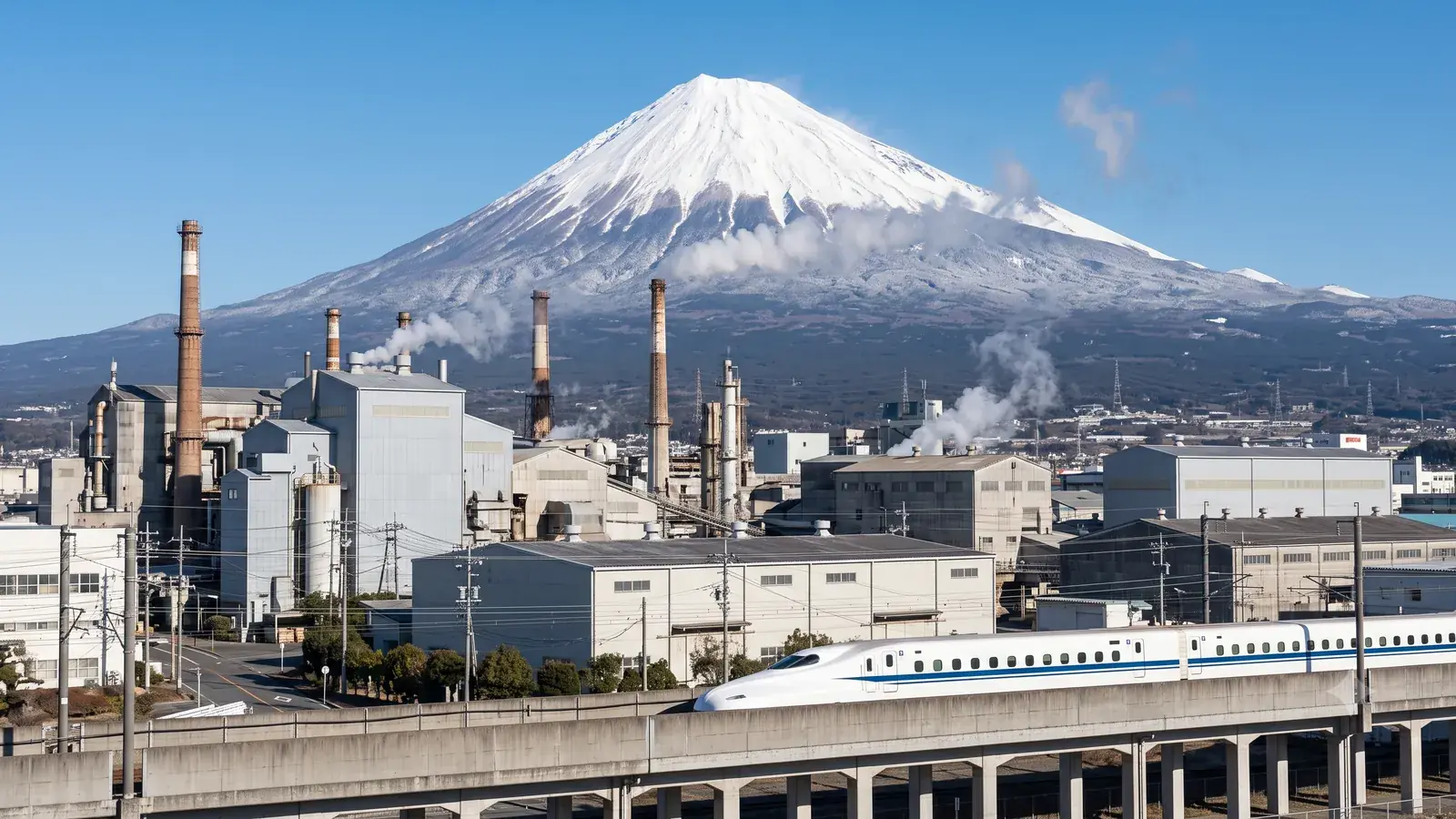
From Mishima toward Fuji City, the window shows a run of townscape and factories. Fuji City is known as the "City of Paper": it grew into a center of household-paper production on the strength of abundant water — spring water filtered through Mt. Fuji and surface water from the Fuji River. About 40 percent of all toilet paper made in Japan is produced in this one city (Fuji City). That is why chimneys and mill buildings line the window: industry sustained by Mt. Fuji's water stands in front of Mt. Fuji itself.
Paper-mill buildings and chimneys sharing the frame with Mt. Fuji is the signature view of this section. If you would rather photograph the mountain with nothing extra in the frame, the Fuji River crossing is the better spot. Even within the same section, the picture you are after decides when to get ready. How to shoot from a moving train is covered in How to photograph Mt. Fuji from the Shinkansen window.
Sometimes the mountain is hidden longer than it is visible
Even glued to the window, you will not see the mountain the whole time. Three things get in the way.
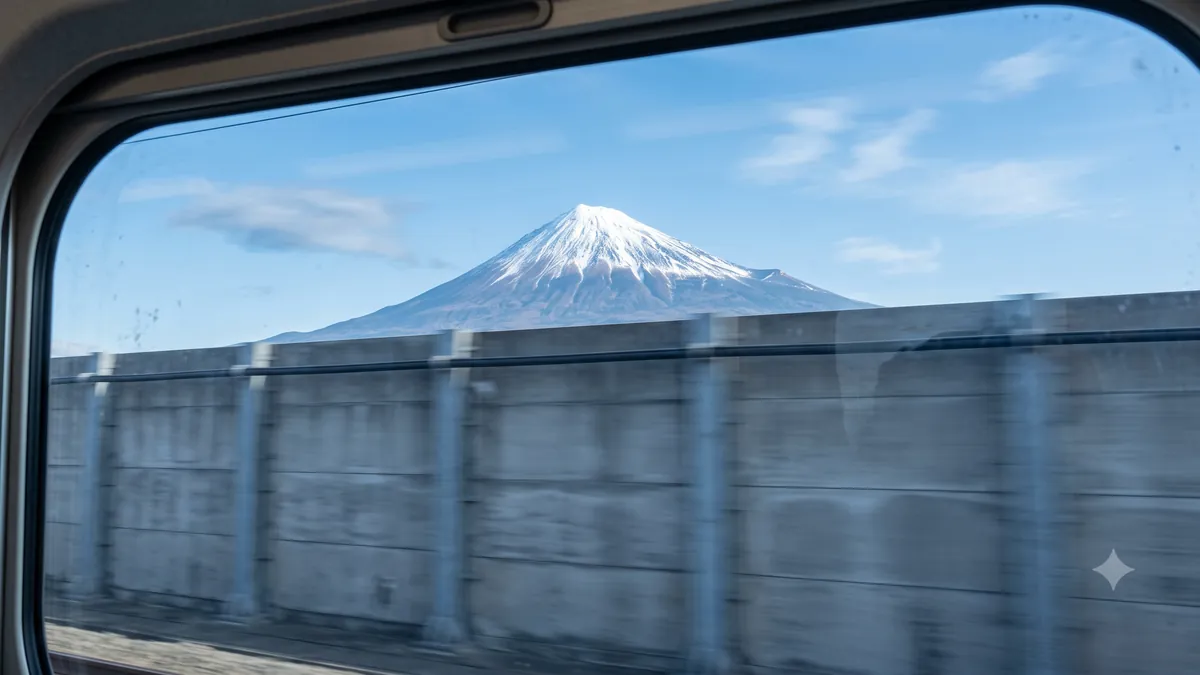
Inside tunnels you naturally see nothing. Next come the trackside walls. Shinkansen noise is subject to environmental standards, and the survey items used to assess compliance include "type of sound barrier" and "height of sound barrier" (Ministry of the Environment). From your seat, the bottom of the view is cut off by exactly the height of those walls — which is why you often see the summit poking out while the skirt is hidden. The third obstacle is cloud, and it is the least predictable. Seasonal and time-of-day tendencies are summarized in How often Mt. Fuji is actually visible.
The Fuji-side seats are seat E in ordinary cars and seat D in Green Cars, the same in both directions. The reason is explained in Why Mt. Fuji is so easy to see from the Shinkansen.
How many minutes is it visible? (This site's times are estimates)
This site presents the span from first view to last view as roughly five to six minutes. That is a guide, not a guaranteed duration. In practice the walls and buildings described above keep interrupting the view, so the mountain is continuously visible for only a few minutes of that span.
Bear in mind that Nozomi and Hikari trains do not stop at Shin-Fuji; only Kodama trains do (JR Central Tours). Because passing times at non-stop stations are not published in timetables, there is no official figure for the minute a given train passes in front of Mt. Fuji. This site estimates it as elapsed time from an officially known time: for Nozomi, departure from Tokyo (westbound) or from Nagoya (Tokyo-bound — Nagoya is used because Tokyo arrival times cannot be retrieved mechanically); for Hikari, the passing time is derived from the stops on either side. Only for Kodama can the official departure time at Shin-Fuji itself be used, which narrows the estimate — though first view and last view are still guides within a few minutes' margin, allowing for the stop and slow running. The train data follows the timetable revision of March 14, 2026 (JR Central).
Enter your train number and you get the estimated times and the side to sit on. Check Mt. Fuji from the Shinkansen (the time calculator) before departure and choose your seat, and you can turn to the window before the section begins. Even after the train is moving, the train number is all you need.
Sources
- GSI, "Elevations of Principal Mountains in Japan (1,003 peaks)" (in Japanese) — list PDF/CSV; Mt. Fuji (Kengamine) 3,776 m
- JR Central, "Station Guide" (in Japanese) — order of Tokaido Shinkansen stations (Mishima, Shin-Fuji, Shizuoka)
- JR Central, "Going to Mt. Fuji? Take the Shinkansen — seats and travel times" (in Japanese) — "the main Mt. Fuji viewing sections are Shin-Yokohama–Odawara and Mishima–Shin-Fuji"; row E
- JR Central Tours, "Tokaido Shinkansen stops at a glance" (in Japanese) — list of stops; only Kodama stops at Shin-Fuji, Nozomi and Hikari pass through
- Fuji City, "Chapter 1: Overview of Fuji City" (PDF, in Japanese) — city area 23.2 km east–west, 27.1 km north–south; northern edge directly below the summit; about 3,680 m of elevation difference; the west bank of the Fuji River mostly steep mountains
- Fuji City, "17: Shin-Fuji Station Mt. Fuji Exit" (in Japanese) — city viewpoint; "step off the Tokaido Shinkansen and Mt. Fuji greets you"
- Fuji City, "Recommended Mt. Fuji Viewing Spots" (in Japanese) — the Fuji River, Fujikawa Rakuza roadside station, around Shin-Fuji Station
- Fuji City, "Fuji, the City of Paper" (in Japanese) — spring and surface water; about 40% of Japan's toilet paper
- MLIT Kanto Regional Development Bureau, Kofu River and National Highway Office, "The Fuji, one of Japan's three swiftest rivers!" (in Japanese) — one of the three swiftest rivers alongside the Mogami and the Kuma; waterway between Kai and Suruga
- Ministry of the Environment, "Manual for Measuring and Evaluating Shinkansen Railway Noise" (in Japanese) — survey items in section 4.4 include "type of sound barrier" and "height of sound barrier"
- JR Central, "On the March 2026 Timetable Revision" (PDF, in Japanese) — "the timetable revision takes effect on Saturday, March 14, 2026"
All illustrations on this page are AI-generated images, not photographs of the actual scenery.