How Often Mt. Fuji Is Actually Visible — Winter vs. Summer, Morning vs. Noon
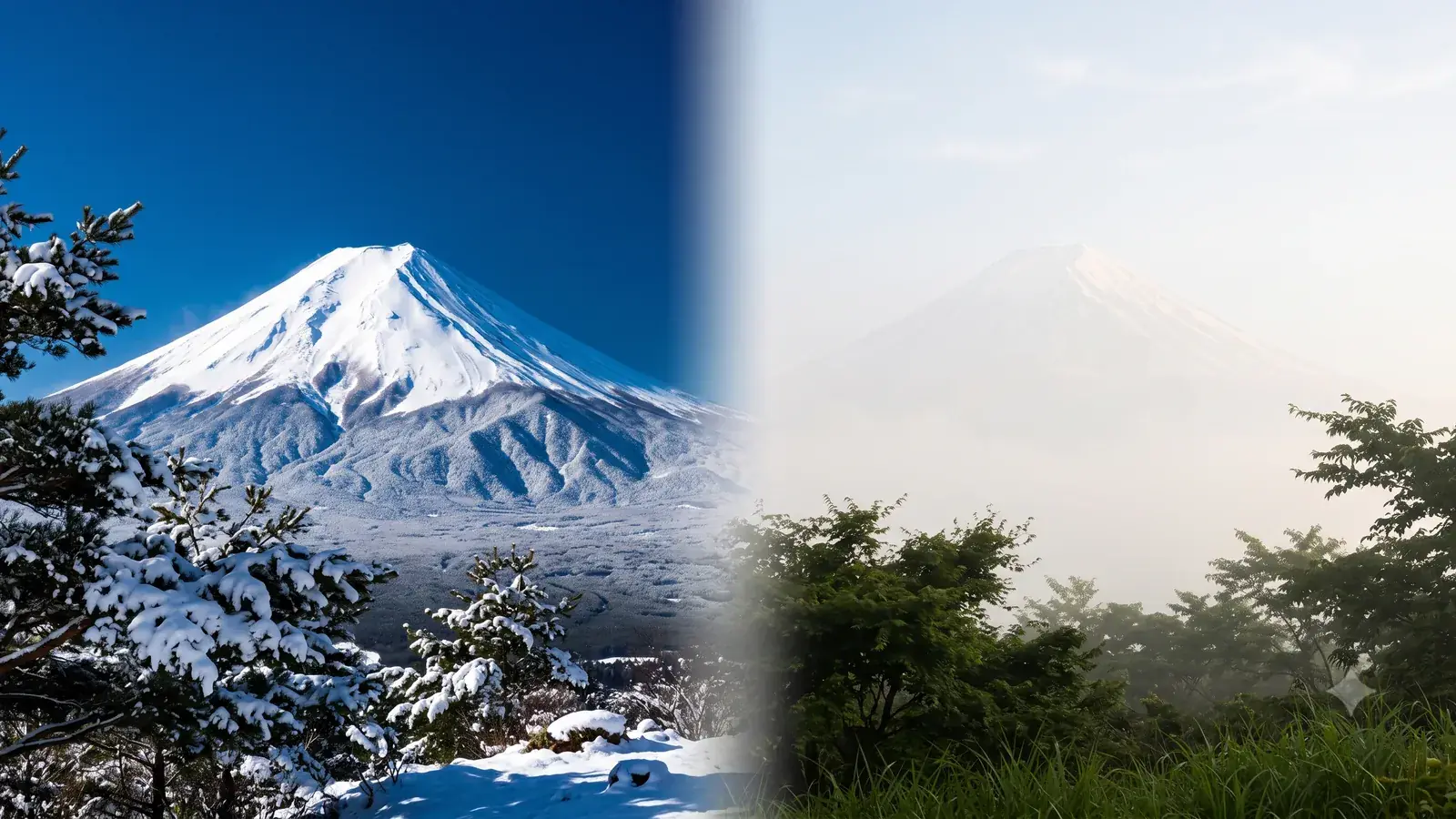
How often Mt. Fuji can be seen varies sharply with the season and the time of day. Using figures from 35 years of fixed-point observations accumulated by Fuji City, this article shows how often the mountain is visible by month and by hour, and then checks the reasons summer hides it against Japan Meteorological Agency data. It closes with a word on how to take it when the mountain doesn't show.
Enter your train number and see when Mt. Fuji appears→Fuji City has recorded the mountain three times a day for 35 years
Fuji City began observing in May 1990. From the 8th floor of its city hall (the 6th floor in the early years), staff check Mt. Fuji three times a day — at 8:00, 12:00 and 16:00 — by fixed camera or by eye, and classify the result three ways: fully visible, partly visible, or not visible at all. The published records now cover the 35 years from 1991 to 2025.
Note that the observations are from a single point on the 8th floor of city hall, which differs in height and angle from a moving train window. Read the numbers below not as the view from the train itself, but as a picture of how the sky around Mt. Fuji changes with season and time of day.
The 8 a.m. observation was made 12,784 times over 35 years. The mountain was fully visible 4,684 times — 36.6% — and adding "partly visible" brings the figure to 58.9%. In other words, the full mountain shows on a bit more than one morning in three, and at least a piece of it on three to four mornings out of six.
How many days a year is Mt. Fuji visible?
Fuji City publishes its records as rates per observation rather than as a count of days, so there is no single official "days per year" figure. But the rates translate readily. A 36.6% rate at the 8 a.m. check corresponds to about 134 mornings a year with the whole mountain in view; counting mornings when at least part of it showed (58.9%) brings that to roughly 215 mornings a year. Spread across the calendar the average hides an enormous seasonal swing — the winter and summer months below differ by a factor of six — so "how many days" depends almost entirely on which months you are asking about.
December: 61.7%. July: 9.9%.
Month by month, the gap is extreme. These are the 35-year totals for "fully visible" at 8 a.m.
| Month | Fully visible |
|---|---|
| January | 60.0% |
| February | 52.6% |
| March | 40.7% |
| April | 36.3% |
| May | 30.2% |
| June | 12.4% |
| July | 9.9% |
| August | 14.6% |
| September | 27.2% |
| October | 41.1% |
| November | 53.9% |
| December | 61.7% |
December and January run around 60%, February just over 50%. June through August, by contrast, drop to around 10%; in July, "not visible at all" accounts for 75.4%. On summer mornings, expect the full view about one day in ten — that matches the data. Fuji City's own summary of the 35 years says the months with many visible days are November through February and the fewest are June through August, and that the rate is also low in March through May, when spring haze tends to form, and in September, the typhoon season.
Why winter shows the mountain and summer hides it
Winter visibility comes from the winter pressure pattern. The JMA explains that in winter the Siberian High strengthens: the Sea of Japan side gets heavy snow, while the Pacific side sits under dry winds blowing down off the mountains and enjoys many clear days. The air is dry, sight lines run long, and little cloud hangs on Mt. Fuji. Winter is good because those two things coincide.
Summer is the reverse. In the Tokai region the rainy season starts around June 6 and ends around July 19 on average (1991–2020). From June to mid-July the area sits under the seasonal rain front, and after it lifts, the Pacific High takes over and moist air streams in from the south. At Mishima, southeast of Mt. Fuji, the climatological normals put relative humidity highest in July at 76%, against 63% in February. On mountain weather, the JMA explains that when moist wind off the lowlands strikes a mountain, it runs up the slope, cools aloft and forms cloud. The humidity gap at Mishima is one indicator that the inflow of moist air has a strong seasonal cycle.
The point to hold on to: even a sunny day does not mean Mt. Fuji is visible. Mishima's normals put August sunshine at 191.0 hours, the longest of the year — yet August's "fully visible" rate, 14.6%, is among the lowest. In Fuji City's 2025 records, August had 16 sunny days but only 3 days when the whole mountain showed. The city notes explicitly that fine weather does not necessarily mean the mountain is visible, and that the sunny-day rate and the visible rate are not proportional. Blue sky overhead means nothing if cloud is boiling around the summit.
Morning is your best chance
The time-of-day difference is just as clear. Over the 35 years, "fully visible" runs 36.6% at 8:00, 23.3% at 12:00 and 22.5% at 16:00. Including "partly visible," the figures are 58.9%, 53.4% and 49.7% — declining through the afternoon. Fuji City states the tendency plainly: the mountain becomes harder to see as the afternoon wears on.
The city's material does not explain the mechanism behind this trend. Among the processes likely involved: the JMA defines "heat thunderstorms" as lightning that develops locally in summer under strong solar heating — so at least in the warm season, strong sunshine driving convection is built into the forecasting vocabulary. Add to that the slope effect described above, where moist wind climbing the mountainside builds cloud. In the morning, the ground has not yet warmed and solar-driven convection has barely begun.
If you can choose when to travel, a morning train has the edge. You can check when your train passes the viewing section on Mt. Fuji from the Shinkansen (the time calculator) — the times shown are estimates.
Spring haze and autumn typhoons
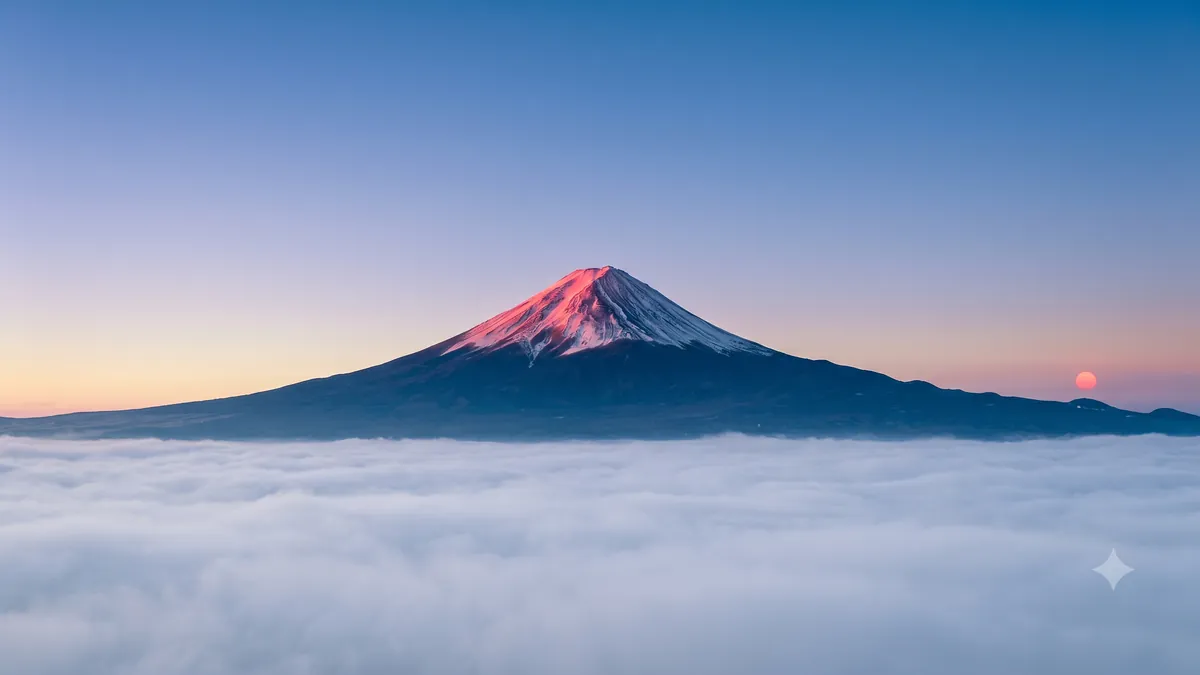
March through May falls short of winter: 40.7% in March, 36.3% in April, 30.2% in May. Fuji City attributes this to spring haze. Incidentally, "kasumi" (haze) is a word the JMA's forecast glossary says it does not use, having no observational definition; observationally the condition is treated as "mist" (visibility of 1 km to under 10 km) and the like. The sky is clear, but the distance fades to white.
September stays low at 27.2%. The JMA's climatological normals put typhoon approaches at their peak in August and September — 3.3 each — and the autumn rain front adds to it. The numbers recover from October's 41.1%, through November's 53.9%, to the December peak of 61.7%.
There is a day-by-day figure too
Fuji City also publishes a calendar giving, for every date in the year, the share of observations in which Mt. Fuji was visible. It was compiled with the National Institute of Technology, Numazu College, from 33 years of records, 1991 to 2023. Those figures run consistently lower than the monthly 8:00 tables above, averaging 26.8% across the 365 days. That is close to the average of the 8:00, 12:00 and 16:00 figures (27.5%). The calendar itself does not state which observation times it covers, but Fuji City's City Promotion Division confirmed to us that every one of the three daily observations — 8:00, 12:00 and 16:00 — goes into the denominator, with the number of "fully visible" results as the numerator for each date (reply of 13 August 2026, given after the city checked with Numazu College). The city's own tally now runs to 34 years, while the version published on the web covers 33.
The calculator on this site shows those daily figures smoothed over a window of seven days either side. Each date rests on only 33 years of records, so neighbouring dates can differ by more than 20 points. Smoothing brings out the change within a month: early October sits at 17% and the end of the month at 36%, more than double. A single monthly figure hides that.
When the mountain doesn't show
Days without a view are perfectly normal. Across the 35 years, "not visible at all" at 8 a.m. is about 41% — which also means some part of the mountain showed on about 59% of mornings. Given that the full view appears on only 36.6%, a day when you catch the whole mountain deserves to be counted as good luck.
Even so, don't give up too quickly. "Partly visible" accounts for 22.3%, and states like a cloud-capped summit above a spreading skirt — or just the summit poking above a sea of cloud — occur quite often. The clouds that gather on Mt. Fuji are a sight in their own right; cap clouds and lenticular clouds are covered in What cap clouds and lenticular clouds tell you about Mt. Fuji's weather.
If you want to know the current sky before boarding, Mt. Fuji from the Shinkansen (the time calculator) has a weather card showing cloud cover near Fuji City. Even on a cloudy day, the passage takes only a few minutes. The window is worth watching.
Sources
- Fuji City, "Records of Mt. Fuji Observation" (in Japanese)
- Fuji City, "Records of Mt. Fuji Observation — 2025 Report" (PDF, in Japanese)
- Fuji City, "How Often Mt. Fuji Was Visible" (day-by-day calendar, in Japanese)
- JMA, "Overview of Japan's Climate" (in Japanese)
- JMA, "Past Rainy Season Onset and End Dates (Tokai)" (in Japanese)
- JMA, "Climatological Normals for Mishima, Shizuoka (annual/monthly)" (in Japanese)
- JMA, "Climatological Normals for Typhoons" (in Japanese)
- JMA forecast glossary, "Ice, Frost, Fog, Thunder, Sunshine Duration" (in Japanese)
- JMA, "Why Does Mountain Weather Change So Quickly?" (in Japanese)
- Reply from the City Promotion Division, Fuji City (email, 13 August 2026; given after the city checked with Numazu College)
- Observation data provided by Fuji City
All illustrations on this page are AI-generated images, not photographs of the actual scenery.