Why Mt. Fuji Is a World Cultural Heritage Site — Not a Natural One
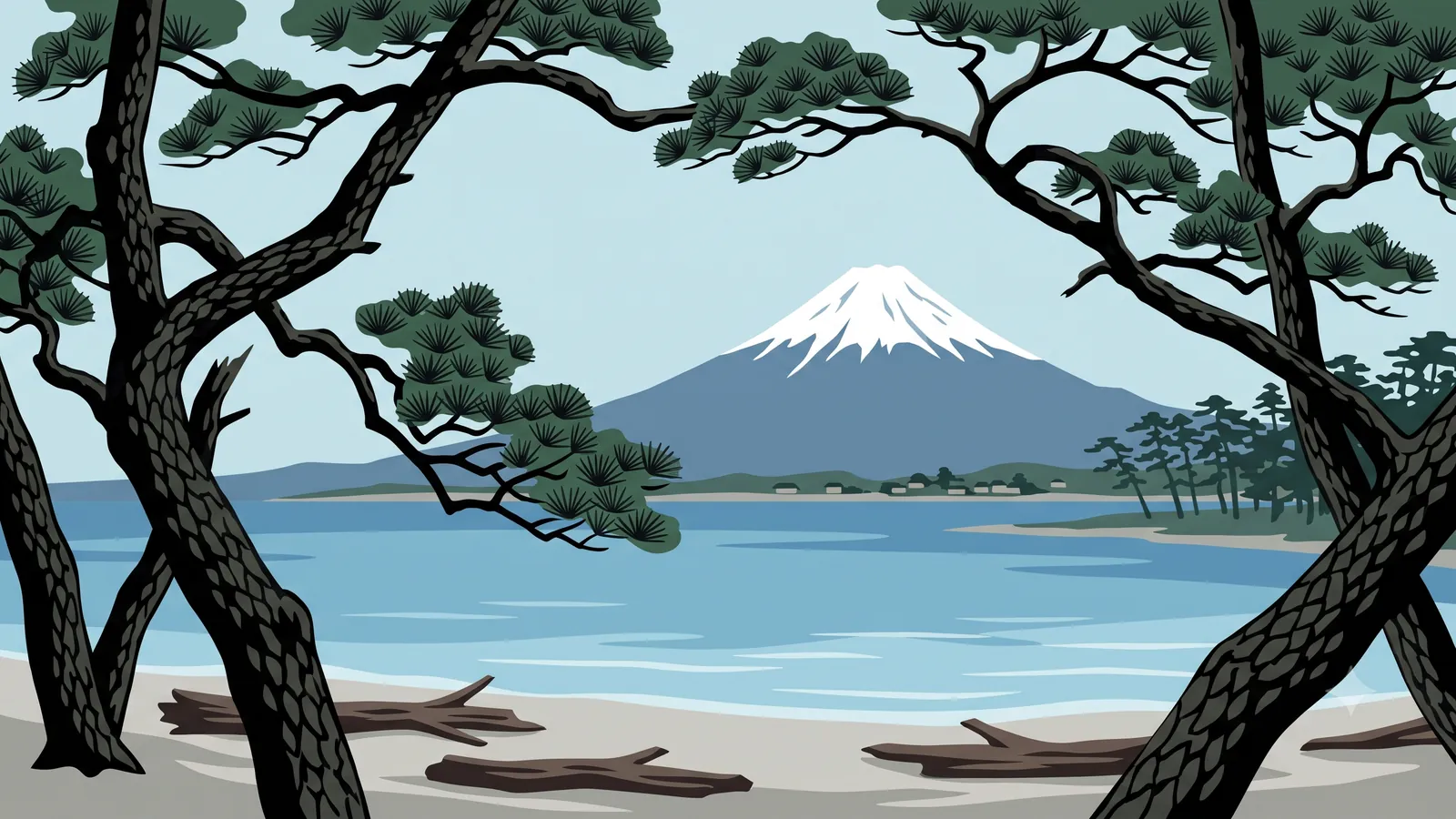
Mt. Fuji became a World Heritage site in 2013 — and in the cultural category, not the natural one. This article sorts out what the official name means, why the listing was not as a natural site, what the 25 component parts consist of, and how the "source of artistic inspiration" evaluation connects even to the mountain you see from a train window — keeping to what can be verified in official sources.
Enter your train number and see when Mt. Fuji appears→June 22, 2013: inscribed, "including Miho no Matsubara"
According to the Agency for Cultural Affairs' bulletin, the 37th session of the UNESCO World Heritage Committee, meeting in Phnom Penh, Cambodia, decided at 15:28 local time on June 22 to inscribe the property on the World Heritage List "including Miho no Matsubara." The inscribed name is "Fujisan, sacred place and source of artistic inspiration."
The nomination dossier had been submitted to UNESCO in January 2012 as a joint nomination by the Agency for Cultural Affairs, the Ministry of the Environment and the Forestry Agency. The Ministry of the Environment cites two evaluation criteria: (iii) evidence of a unique cultural tradition centered on the mountain — Fuji worship — that is, an object of faith; and (vi) direct and tangible association with artistic works of outstanding universal significance — that is, a source of artistic inspiration. The name itself states the grounds for inscription.
The natural-heritage shortlist had dropped it ten years earlier
Mt. Fuji was also considered as a natural site. In 2003 the Ministry of the Environment and the Forestry Agency convened an expert panel on candidate natural World Heritage sites and included Mt. Fuji among 19 areas for detailed review. But the panel's report of May 26 that year judged only three areas — Shiretoko, the Ogasawara Islands and the Ryukyu Islands — "highly likely to satisfy the inscription criteria and conditions of integrity." Mt. Fuji was not among them.
The fourth session's summary table lays out facts for and against Mt. Fuji side by side. In its favor: a solitary stratovolcano exceeding 3,000 m with diverse lava landforms, and an aesthetic landscape unrivaled in Japan as a free-standing peak. Against it: the site does not encompass diverse volcano types; large stratovolcanoes are already represented on the List by Kilimanjaro National Park; the lower slopes (first to third stations) have been extensively modified by human activity; and a conservation management system needed to be established, including for garbage and human-waste problems. The document is a survey table of all the candidates, not a paper titled "why Fuji was dropped" — but it shows where the weaknesses were seen to lie.
The same report added that areas not selected might still merit consideration in fields such as cultural landscapes. Yamanashi Prefecture's chronology likewise records Mt. Fuji surfacing as a natural-heritage candidate in March 2003 and dropping off the list in May; the push for cultural-heritage listing began in earnest from 2005.
Cultural listing did not end nature protection, either: the Ministry of the Environment explains that 99% of the property's area is national park under the Natural Parks Act.
The 25 component parts are the apparatus of worship
There are 25 component parts. The central "Fujisan Mountain Area" itself contains the shrine remains near the summit, the four ascending routes — Omiya-Murayama, Suyama, Subashiri and Yoshida — Kitaguchi Hongu Fuji Sengen-jinja Shrine, and lakes Saiko, Shojiko and Motosuko.
The rest comprise the Sengen shrines led by Fujisan Hongu Sengen Taisha, the oshi lodging houses that received pilgrims, lakes Yamanakako and Kawaguchiko, the Oshino Hakkai springs, the Funatsu and Yoshida lava tree molds, the Hitoana Fuji-ko site, Shiraito no Taki waterfall, and Miho no Matsubara. Shrines, trails, springs and lava caves share one list because most of them are tied to the single practice of climbing the mountain in worship. Miho no Matsubara alone is different in character — more on that below.
Object of faith: from a mountain worshipped from afar to a mountain climbed
By Shizuoka Prefecture's account, from antiquity through the late Heian period Mt. Fuji was worshipped from a distance (yohai). Once eruptions subsided in the late Heian period, the mountain became a training ground of Shugendo — mountain asceticism fused with esoteric Buddhism — and the mountain worshipped from afar became a mountain climbed in worship (tohai). By the late Muromachi period, ordinary people were climbing alongside the ascetics.
What boomed in the Edo period was Fuji-ko, the lay pilgrimage confraternities. The founder figure is Hasegawa Kakugyo (1541–1646), who performed austerities at the Hitoana cave and elsewhere. His lineage was organized by successors Murakami Kosei and Jikigyo Miroku, and Shizuoka Prefecture records that during the two months each year when the mountain was ritually open, an average of ten to twenty thousand people climbed it in worship. Women were barred from the mountain until the Grand Council of State proclamation of 1872.
Source of artistic inspiration: ukiyo-e carried Mt. Fuji abroad
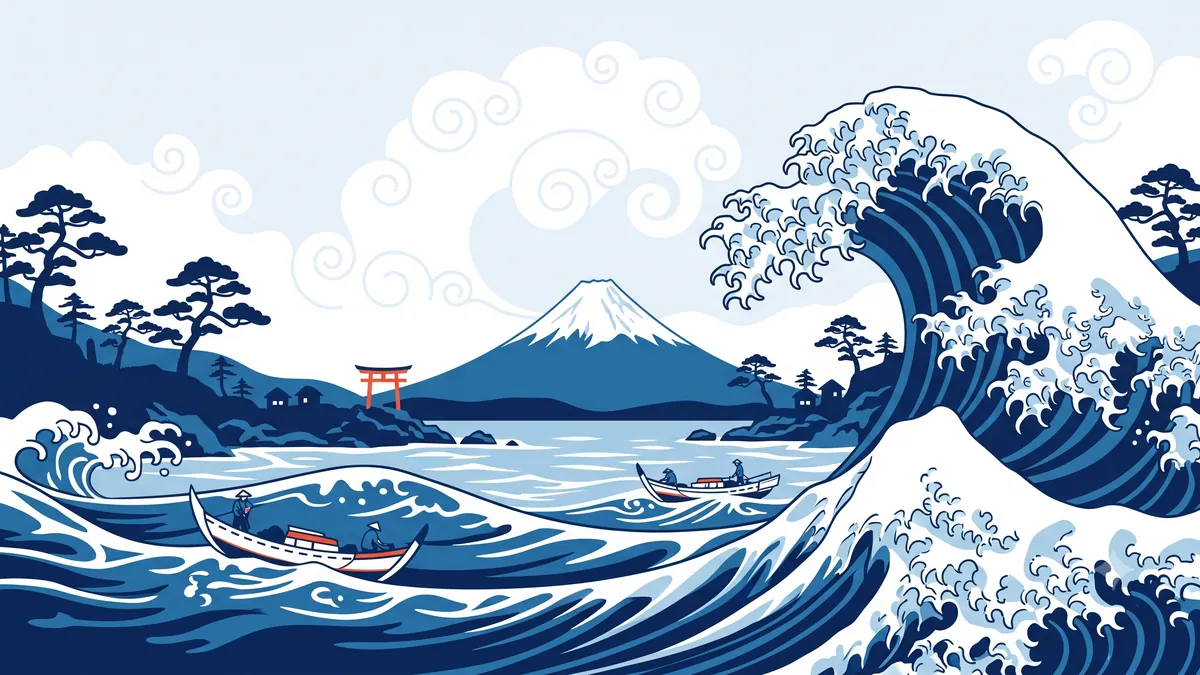
The other criterion is art. According to Shizuoka Prefecture's World Heritage division, the ukiyo-e of Hokusai and Hiroshige began traveling overseas with the opening of Japan at the end of the Edo period; their showing at the 1867 Paris Exposition drew attention and set off "Japonisme" in Europe. Van Gogh, Monet, Manet, Cézanne and other painters absorbed the influence — Hiroshige's Mt. Fuji appears in the background of Van Gogh's "Portrait of Père Tanguy" — and Henri Rivière, taking Hokusai's Thirty-six Views of Mount Fuji as his model, produced the Thirty-six Views of the Eiffel Tower.
The "source of artistic inspiration" evaluation, in other words, is not merely a statement that Japan has long painted this mountain. It says Western art itself changed, and this mountain stands at the source. The difference between Hokusai's red Fuji and the real phenomena of Akafuji and Beni-Fuji is covered in Akafuji, Beni-Fuji and Diamond Fuji — what's the difference?.
Miho no Matsubara: why a site 45 km away belongs to the property
Miho no Matsubara lies about 45 km southwest of the summit — the farthest of the component parts. A pine grove spreads along a sand spit thrust into Suruga Bay, and the spot has been a subject of waka poetry since the Man'yoshu and the setting of a Noh play. From the 15th–16th centuries onward, the composition placing Miho no Matsubara in the foreground became the archetype of Mt. Fuji painting. It is valued not as a stage of pilgrimage but under criterion (vi), as a source of artistic inspiration.
And it is the one part that nearly fell off the list. Shizuoka Prefecture's records show that the ICOMOS recommendation delivered on April 30, 2013 was for inscription "excluding Miho no Matsubara." The Committee overturned that on June 22, deciding to inscribe the property with Miho no Matsubara included. Hakubun Shimomura, then Minister of Education, commented on his pleasure that the Committee had endorsed listing Miho no Matsubara as part of the whole. As for why the recommendation had proposed excluding it, Shizuoka Prefecture's published materials do not say.
Miho no Matsubara is not a place you view from the Shinkansen window; it is a place you get off and go to. Directions are collected in Getting off the Shinkansen to see Mt. Fuji.
The view from the train window stands in the same lineage
The Mt. Fuji of the ukiyo-e prints was the Mt. Fuji seen by travelers on the old Tokaido road. Looking for the same mountain from a Shinkansen window today is a continuation of that. Enter your train number and Mt. Fuji from the Shinkansen (the time calculator) gives approximate times and the side to sit on. These are estimates based on departure times at stops, and the weather carries no guarantee — some days the mountain does not show. On those days, consider it an excuse to visit one of the 25 component sites instead.
Sources
- Agency for Cultural Affairs, "Bulletin: Decision to Inscribe 'Fujisan' on the World Heritage List" (June 22, 2013; PDF, in Japanese) — 37th Committee session; 15:28 local time, June 22; inscription including Miho no Matsubara; the inscribed name; Minister Shimomura's comment
- Ministry of the Environment, "Inscription of the World Cultural Heritage 'Fujisan, sacred place and source of artistic inspiration'" (in Japanese) — dossier submitted January 2012 as a joint nomination by the Agency for Cultural Affairs, Ministry of the Environment and Forestry Agency; criteria (iii) and (vi); 25 component parts
- Ministry of the Environment, "World Cultural Heritage 'Fujisan'" (in Japanese) — 99% of the property's area designated national park under the Natural Parks Act
- Expert Panel on Candidate Natural World Heritage Sites, "On the Panel" (May 26, 2003; PDF, in Japanese) — 19 areas for detailed review (Mt. Fuji in the annex); Shiretoko, Ogasawara and Ryukyu judged highly likely; note on cultural-landscape avenues
- Same panel, 4th session, Document 4: "Summary Table of Areas under Detailed Review" (PDF, in Japanese) — Mt. Fuji's evaluation; ● marks denote facts counting against; no diverse volcano types; represented by Kilimanjaro National Park; human modification of the lower slopes (stations 1–3); conservation management including garbage and human waste
- Yamanashi Prefectural Fujisan World Heritage Center, "The Road to Inscription" (in Japanese) — surfaced as a natural candidate March 2003, dropped May 2003; founders' meeting of the national council for cultural listing March 2005; inscription decided June 22, 2013
- Yamanashi Prefecture, "The Component Parts of 'Fujisan'" (in Japanese) — list of the 25 parts, from the mountain area to Miho no Matsubara
- Shizuoka Prefecture, "Introduction to the Component Parts" (in Japanese) — elements within the mountain area (summit shrine remains, four ascending routes, Kitaguchi Hongu Fuji Sengen-jinja, lakes Saiko, Shojiko, Motosuko)
- Shizuoka Prefecture, "The Road to Mt. Fuji's World Heritage Inscription" (in Japanese) — the ICOMOS recommendation of April 30, 2013: inscription "excluding Miho no Matsubara" (no reasons recorded)
- Shizuoka Prefecture Mt. Fuji World Heritage Division, "Mt. Fuji Complete Guide: Fuji Worship" (in Japanese) — from worship-from-afar to climbing worship; Shugendo training ground; commoners from the late Muromachi period
- Same, "Fuji-ko" (in Japanese) — Hasegawa Kakugyo (1541–1646); lineage organized by Murakami Kosei and Jikigyo Miroku; an average 10,000–20,000 pilgrims in the two-month open season; women's ban lifted by the 1872 proclamation
- Same, "Mt. Fuji's Influence on the West" (in Japanese) — the opening of Japan and the 1867 Paris Exposition; Japonisme; Van Gogh's "Portrait of Père Tanguy"; Rivière's Thirty-six Views of the Eiffel Tower
- Same, "Component Parts: Miho no Matsubara" (in Japanese) — about 45 km southwest of the summit; sand spit; the Hagoromo legend; the archetypal composition from the 15th–16th centuries
All illustrations on this page are AI-generated images, not photographs of the actual scenery.